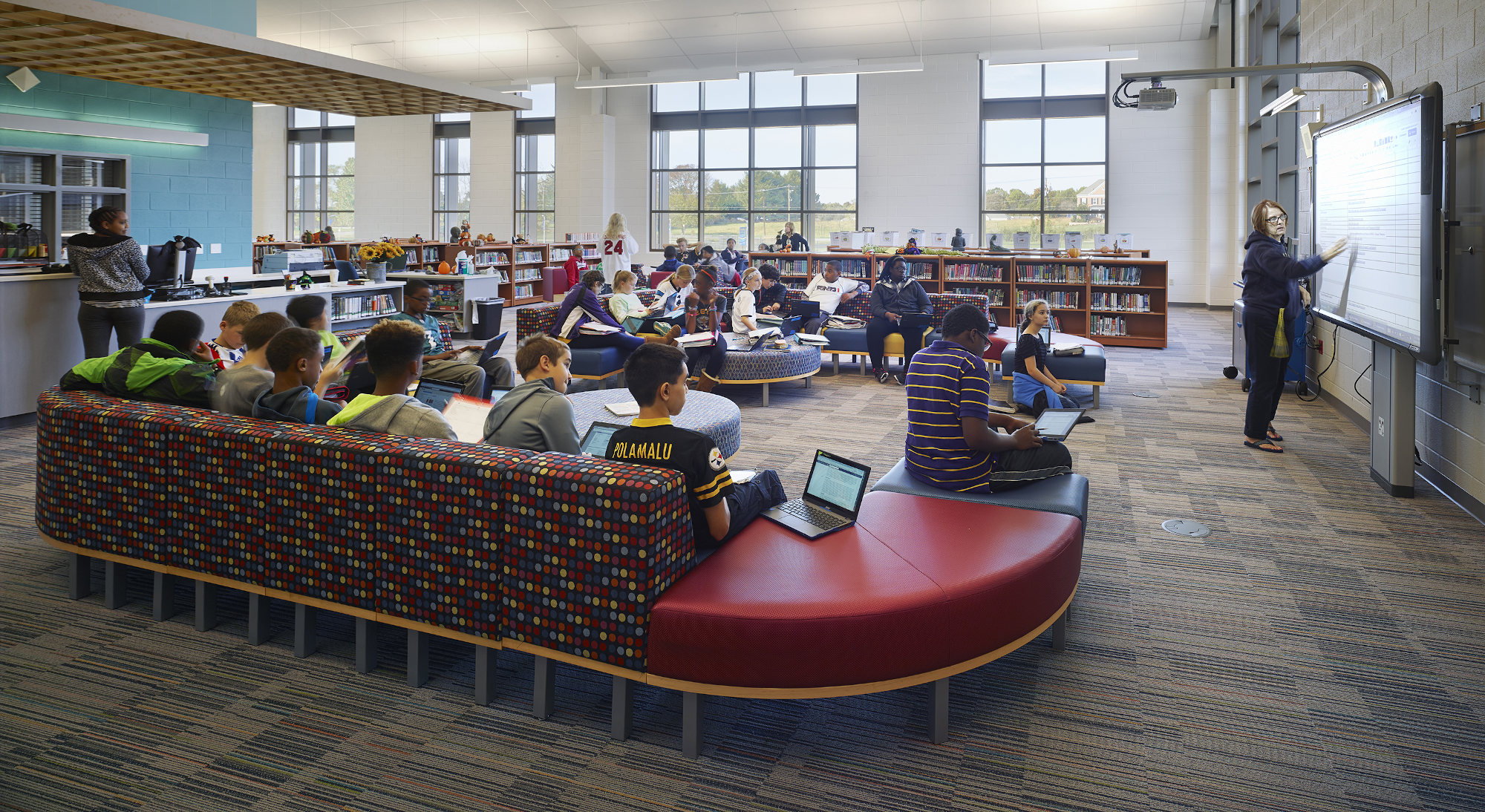
William H. Farquhar Middle School, Olney, MD. Photo credit: Patrick Ross
School Health Research Library
We have curated a library of peer-reviewed scientific studies from around the world published since 2016, focusing on the school built environment and occupant health and performance. This research builds on the 2017 Schools for Health: Foundations for Student Success report released by Harvard T.H. Chan School of Public Health that synthesizes foundational research about school indoor environmental quality impacts on students and staff.
To help translate this research into action in schools, we have compiled School Health Research Highlights to help school staff and leaders access key findings and actionable strategies on priority topics.


Displaying 511 - 520 of 680 | Export entire research library
Proximity of schools to roads and students’ academic performance: A cross-sectional study in the Federal District, Brazil
Requia, Weeberb J.
Analyzed test scores from 344,175 Brazilian students across 256 public schools. Greater road length near schools was linked to lower academic performance. Highlights environmental planning to protect learning in polluted urban zones.
Keywords: Traffic emissions, Students, Academic performance, Cross-sectional study, Brazil
Volatile Organic Compounds in Primary Schools in Ho Chi Minh City, Vietnam: Characterization and Health Risk Assessment
Lu, Khang H.
Indoor and outdoor VOCs were sampled in 4 Vietnam primary schools. Highest VOC levels found indoors; health risk modeled for students using measured concentrations. Study informs air quality management in urban schools.
Keywords: primary school, volatile organic compounds, Btex, Indoor air, Health risk assessment
Investigating dilution ventilation control strategies in a modern U.S. school bus in the context of the COVID-19 pandemic
Van Dyke, Michael
CO₂ tracer decay method was used to measure air change rates under different ventilation configurations in school buses. Highest ACH achieved with windows and hatches open. Findings guide practical airborne infection mitigation during student…
Keywords: air change rate, COVID-19, infection transmission, School bus, Tracer gas
Contribution of influential factors on PM2.5 concentrations in classrooms of a primary school in North China: A machine discovery approach
Yang, Guangfei
Indoor PM2.5 was monitored for 12 months in 10 classrooms using data-driven models. Partial derivative analysis revealed seasonal dynamics and influential contributors. Findings support sensor-based strategies to improve classroom air quality.
Keywords: Indoor PM2.5, Air pollution in classrooms, Machine learning, Data-driven
Investigation of CO₂ production depending on physical activity of students
Kapalo, Peter
CO₂ concentrations were measured in two university classrooms to assess how student physical activity influenced CO₂ generation. Increased physical exertion raised CO₂ levels, indicating inadequate ventilation and informing IAQ design in educational…
Keywords: educational building, Indoor environment, carbon dioxide (CO2) production, Physical activity
Indoor bacterial load and its correlation to physical indoor air quality parameters in public primary schools
Andualem, Zewudu
Cross-sectional study in 51 classrooms at 8 Ethiopian primary schools used settle plate sampling to assess bacterial load and correlate it with PM2.5, PM10, temperature, and humidity. Findings call for better IAQ control to protect student health.
Keywords: Bacterial load, Classrooms, Correlation, Indoor air, Settle plate method
Indoor PM2.5 concentrations and students’ behavior in primary school classrooms
Zhou, Yuhe
Indoor PM2.5 was monitored in primary classrooms in North China for one year. Symbolic regression models quantified the effect of student behavior on pollution spikes. Findings support managing activity patterns to reduce PM2.5 exposure in schools.
Keywords: Indoor PM2.5, Symbolic regression, students’ behavior
School Indoor Air Quality and Health Risk on the Junior High Schools Students in Depok, Indonesia
Pakpahan, Sasnila
Air quality (PM₂.₅, PM₁₀, CO₂, HCHO) was assessed in 3 Indonesian junior high schools; PM exceeded safe levels, posing health risks. Policy implications include improved school air quality monitoring.
Keywords: PM2.5, PM10, carbon dioxide, Formaldehyde, School health
Understanding teachers' experiences of ventilation in California K-12 classrooms and implications for supporting safe operation of schools in the wake of the COVID-19 pandemic
Sanguinetti, Angela
Surveyed 84 teachers in 11 California schools and paired results with IEQ monitoring; found teachers misunderstood ventilation systems and could not reliably perceive under-ventilation, highlighting the need for CO₂ monitoring and staff training to…
Keywords: Air quality, Classrooms, Occupant perceptions, Thermal comfort, Ventilation
Voice symptoms in teachers during distance teaching: a survey during the COVID‑19 pandemic in Finland
Patjas, M.
Surveyed 121 Finnish teachers on voice symptoms before and during COVID-19 distance teaching. Symptoms were reduced overall, but worsened for teachers with poor room acoustics, dryness, and noise, suggesting environmental risk factors in home…
Keywords: Voice, Teacher, Voice symptoms, Distance learning, COVID-19, Background noise, Air quality, Work ability