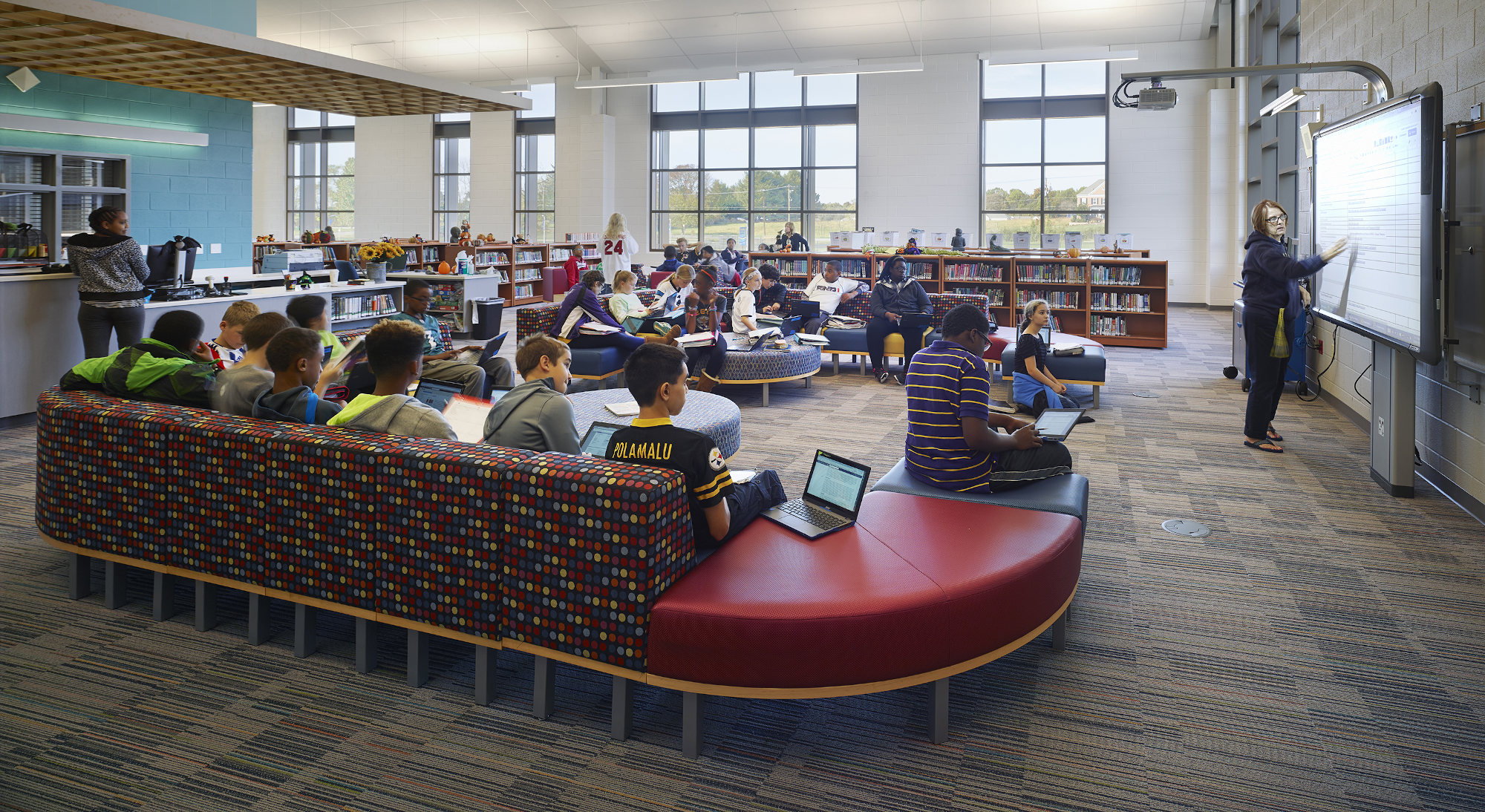
William H. Farquhar Middle School, Olney, MD. Photo credit: Patrick Ross
School Health Research Library
We have curated a library of peer-reviewed scientific studies from around the world published since 2016, focusing on the school built environment and occupant health and performance. This research builds on the 2017 Schools for Health: Foundations for Student Success report released by Harvard T.H. Chan School of Public Health that synthesizes foundational research about school indoor environmental quality impacts on students and staff.
To help translate this research into action in schools, we have compiled School Health Research Highlights to help school staff and leaders access key findings and actionable strategies on priority topics.


Displaying 131 - 140 of 680 | Export entire research library
On the seasonal aerosol pollution levels and its sources in some primary schools in Vilnius, Lithuania
Prokopciuk, Nina
In 11 Lithuanian primary schools, indoor aerosol particle levels were influenced by canteens without ventilation, student activity, furniture, outdoor pollution, and occasional sources like construction and landscaping, highlighting diverse indoor…
Keywords: Primary schools, Indoor/outdoor aerosol, Pollution levels, Systematic sources, Occasional sources, Ventilation
Indoor microbiome, environmental characteristics and asthma among junior high school students in Johor Bahru, Malaysia
Fu, Xi
In 21 Malaysian classrooms, specific bacteria and fungi were linked to asthma severity in 309 students. Protective microbes decreased with dampness and mold, highlighting complex interactions between indoor microbiomes, environment, and asthma in…
Keywords: Bacteria, Fungi, Microbial communities, Absolute quantity, Wheezing, Breathlessness, Adolescents, Dampness/visible mood, Malaysia, Johor bahru, Tropics, Junior high school
Indoor Air Quality Levels in Schools: Role of Student Activities and No Activities
Settimo, Gaetano
This study presents a school IAQ monitoring method measuring chemical (PM2.5, NO2, CO2, VOCs) and physical (temperature, humidity) parameters during school and non-school times, enabling evaluation of student exposure and pollutant source…
Keywords: Indoor air quality , School, Students, Carbon dioxide (CO2), Volatile organic compounds (VOCs), fine particulate matter (PM2.5), Denuder, PCA, Risk
Indoor Radon Measurements in Finnish Daycare Centers and Schools—Enforcement of the Radiation Act
Kojo, Katja
Radon surveillance in Finnish daycare centers (633) and schools (1176) found mean levels around 80 Bq/m³; 8% of daycares and 14% of schools exceeded 300 Bq/m³. Systematic campaigns ensured measurements and reduced radon exposure risk.
Keywords: Radon, Surveillance, School, Daycare center
Indoor environmental quality andlearning outcomes: protocol on large-scale sensor deployment inschools
Temprano, Juan Palacios
A 5-year study of 280 classrooms will monitor indoor environmental quality and cognitive performance in 10,000 children, using continuous sensors and standardized tests. Results will inform science and policy on environment’s impact on child…
Keywords: None listed by authors
Indoor exposure levels of bacteria and fungi in residences, schools, and offices in China: A systematic review
Guo, Kangqi
Reviewing 55 Chinese studies, indoor bacterial levels ranged 72.5-7500 CFU/m³ and fungi 12-9730 CFU/m³, with classrooms showing highest averages. Microbial concentrations varied by climate, highlighting need for unified health-based exposure…
Keywords: Air quality, Bacteria, China, Fungi, Indoor, Systematic review
Indoor air quality at school and students' performance: Recommendations of the UNESCO Chair on Health Education and Sustainable Development & the Italian Society of Environmental Medicine (SIMA)
Pulimeno, Manuela
Poor indoor air quality (IAQ) in European classrooms affects health and learning, with pollutants like CO2, NO2, radon, VOCs, and particulate matter. UNESCO and SIMA recommend actions to improve IAQ, addressing both general and post-COVID-19…
Keywords: Indoor air quality , School, Students, Performance, Health, COVID-19
Morphological Characterization of Indoor Airborne Particles in Seven Primary Schools
Pallarés, Susana
Fine airborne particles in seven Mediterranean schools near an industrial hub were classified into mineral, combustion, and high-temperature industrial types. Results support exposure assessment and highlight need for protective policies in…
Keywords: None listed by authors
Indoor air pollution, physical and comfort parameters related to school children's health: Data from the European SINPHONIE study
Baloch, Ramen Munir
In 5,175 European schoolchildren, exposure to PM2.5, benzene, limonene, ozone, and radon increased risks of respiratory, eye, skin, and systemic symptoms. Higher VOC exposure raised illness odds, while better ventilation reduced some symptoms.
Keywords: Indoor air pollution, Allergy, Volatile organic compounds (VOCs), Sick building syndrome, Multi-pollution, Thermal parameters
Heat stress risk among New York City public school kitchen workers: a quantitative exposure assessment
Ierardi, A. Michael
Heat stress was assessed in 10 NYC public school kitchens; 60-80% exceeded OSHA’s Action Limits for moderate to heavy work, indicating heat-related illness risks. CO2 and CO levels were within typical ranges. Work-rest schedules and controls are…
Keywords: Chef, Cook, Heat-related illness, Heat-related injury, Thermal stress