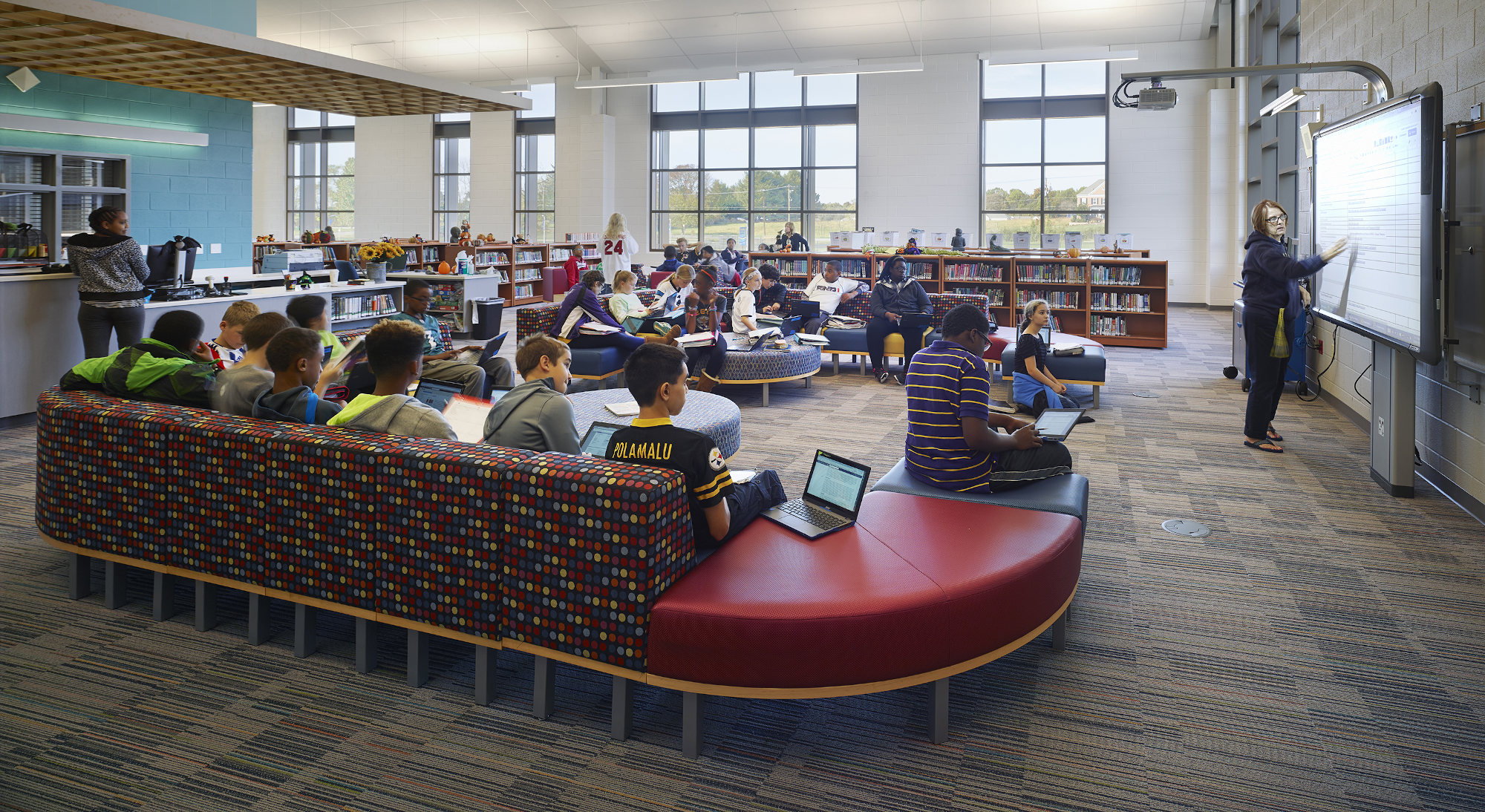
William H. Farquhar Middle School, Olney, MD. Photo credit: Patrick Ross
School Health Research Library
We have curated a library of peer-reviewed scientific studies from around the world published since 2016, focusing on the school built environment and occupant health and performance. This research builds on the 2017 Schools for Health: Foundations for Student Success report released by Harvard T.H. Chan School of Public Health that synthesizes foundational research about school indoor environmental quality impacts on students and staff.
To help translate this research into action in schools, we have compiled School Health Research Highlights to help school staff and leaders access key findings and actionable strategies on priority topics.


Displaying 371 - 380 of 680 | Export entire research library
Assessing a School Gardening Program as an Integrated Component of a Pilot Farm-to-school Initiative Based in South Carolina
Taylor, Carl
Online survey of 37 trained South Carolina educators assessed school gardens’ role in academics and cafeterias. Findings support garden-based learning as a low-cost path to student health and learning gains.
Keywords: School gardens, garden-based learning, experiential learning, Academic performance, childhood obesity
Impacts of Outdoor Environmental Education on Teacher Reports of Attention, Behavior, and Learning Outcomes for Students With Emotional, Cognitive, and Behavioral Disabilities
Szczytko, Rachel
Quasi-experimental study of 161 fifth-grade students with disabilities in North Carolina. Outdoor environmental education improved attention and behavior per teacher reports. Findings support environmental education as an inclusive, science-aligned…
Keywords: environmental education, Attention, Behavior, classroom, schoolyard, learning impairment, disability
A national research agenda supporting green schoolyard development and equitable access to nature
Stevenson, Kathryn T.
This policy-oriented paper proposes a research agenda to support equitable access to green schoolyards in the U.S. Authors outline evidence gaps and cross-sector policy strategies to integrate nature into school environments and improve student…
Keywords: green schoolyards, Education, policy, research agenda, children & nature, sustainable communities
The impact of nature-based education on health-related quality of life among low-income youth: results from an intervention study
Sprague, Nadav L.
Study of 362 low-income students (ages 9-15) in St. Louis evaluating a 15-week nature-based education intervention. Surveys measured changes in HRQoL domains; intervention group showed improved scores. Suggests NBE improves well-being and equity.
Keywords: children, Environment, health promotion
‘I Eat the Vegetables because I Have Grown them with My Own Hands’: Children’s Perspectives on School Gardening and Vegetable Consumption
Sarti, Asia
This Amsterdam-based qualitative study explored how school gardening influenced vegetable consumption among children. Students reported stronger preferences, home advocacy, and pride in eating what they grew—suggesting benefits for diet and…
Keywords: agency, attitudes to vegetables and their consumption, child perspective, school gardening, vegetable consumption
Playability of school-environments and after-school physical activity among 8-11 year-old children: specificity of time and place
Remmers, Teun
Using accelerometers, this Dutch study assessed how “playability” of school areas affects after-school activity in 8-11-year-olds. Results showed proximity and timing matter; better school environments may support physical activity equity.
Keywords: accelerometer, School, Child, Environment, Distance, time specific, methodology, GIS, geospatial information, audit
School Gardens in the City: Does Environmental Equity Help Close the Achievement Gap?
Ray, Rashawn
Using Washington, DC test data, this study assessed whether school gardens help reduce race and class disparities in academic achievement. Students at garden-based schools had higher reading and science scores, suggesting potential for gardens as…
Keywords: Environment, race, Education, achievement gap, racism, social inequality, School gardens, Black
Designing Activating Schoolyards: Seen from the Girls’ Viewpoint
Pawlowski, Charlotte S.
Interviews with 50 Danish girls aged 10-13 explored how schoolyard design influences recess activity. Findings highlight age-related preferences and barriers, offering design insights to improve physical activity equity.
Keywords: recess physical activity, girls, schoolyard renovation, re-design, photo-elicitation interview, pen profile
Bringing Nature to Schools to Promote Children’s Physical Activity
Sharma-Brymer, Vinathe
This opinion paper explores how incorporating natural features into school design may promote children’s physical activity. Drawing from international examples, it argues that school nature integration can support movement, resilience, and wellbeing.
Keywords: None listed by authors
Comparing Classroom Context and Physical Activity in Nature and Traditional Kindergartens
Meyer, Joshua
Naturalistic observation compared 81 students in nature and traditional kindergartens in Western Canada. Nature settings promoted more moderate-to-vigorous activity and unstructured movement. Findings support green environments for early childhood…
Keywords: forest schools, nature-based learning, informal learning, Physical activity, classroom structure, early childhood education