Healthy Air. Healthy Schools.
The impact of improved IAQ in schools
Research shows clear links between indoor air quality and student health, learning, and school performance.
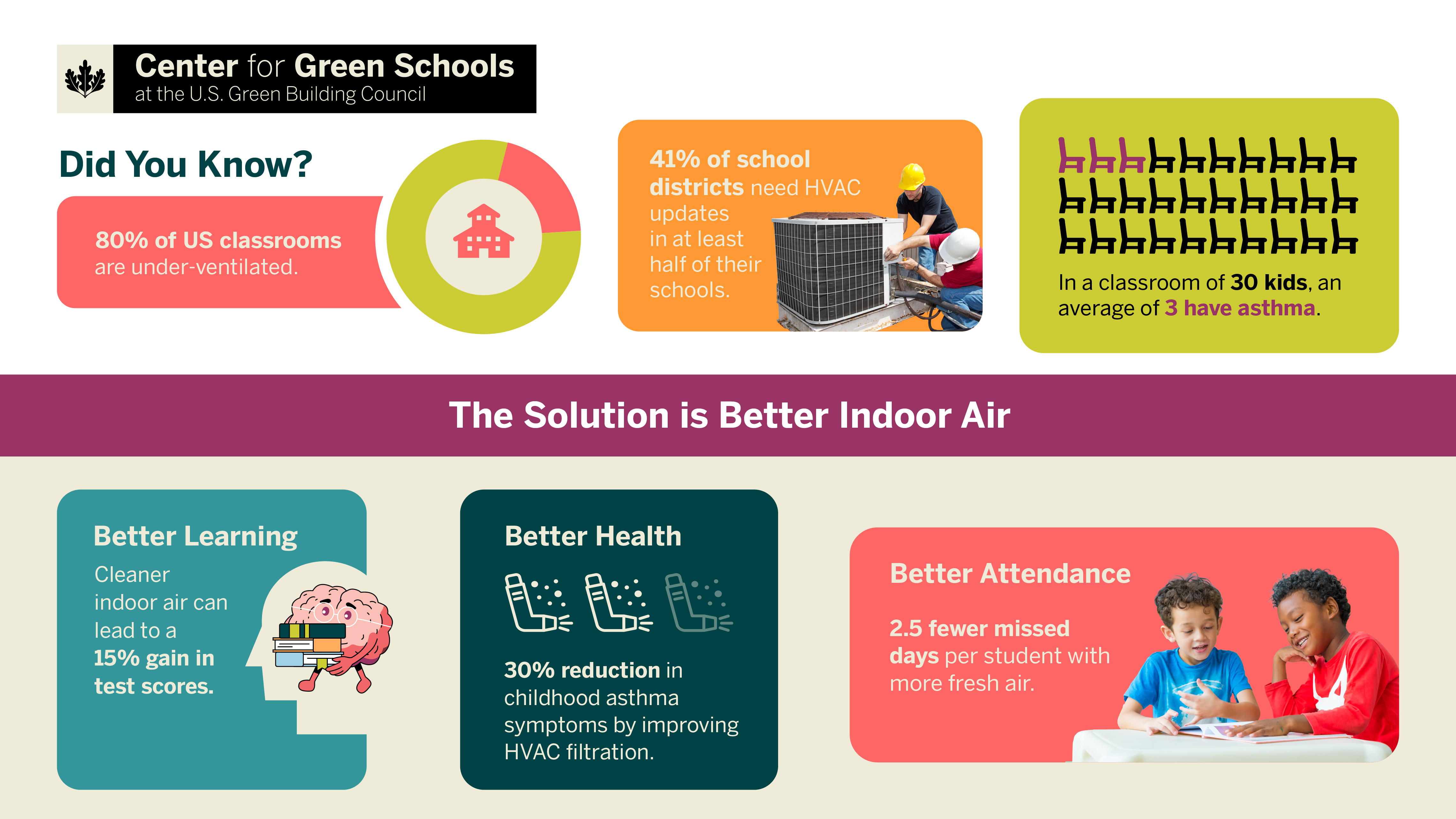
What good IAQ practices deliver
Research shows clear links between indoor air quality and student health, learning, and school performance. Explore our full library of environmental health studies.
Health & wellbeing
Fewer asthma triggers, reduced illness-related absences, and better day-to-day wellbeing.
Better learning environments
More comfortable classrooms support concentration, academic performance, and participation.
Stronger, more efficient schools
Improve school operations by reducing energy costs, preventing costly repairs, and addressing maintenance needs.
Common challenges
Improving indoor air quality is achievable, but schools often face practical, financial, and operational barriers. Explore and click on the different challenges below to find solutions and practical guidance for the IAQ issues schools face most.

School Air Quality Fellowship
The Center for Green Schools is excited to host the 2026–2027 School Air Quality Fellowship, supporting 53 K–12 public school district facilities leaders. Fellows receive practical training plus individualized, district-specific coaching to help turn IAQ and energy goals into an implementable plan alongside a trusted network of peer districts and technical experts.
Featured resources
IAQ Management Plan Toolkit
Turn awareness into action with this step-by-step toolkit. Help your school district develop, implement, and sustain an effective IAQ program.
School IAQ Fact Sheet Series
Explore the many issues that affect indoor air quality in schools, including ventilation, filtration, mold, wildfire smoke, and other important topics.
Clean Air in Schools Course
Build a strong foundation in school indoor air quality. Explains why IAQ matters, highlights common risks, and provides practical strategies.
- Deng, S., Zou, B., & Lau, J. (2021). The adverse associations of classrooms’ indoor air quality and thermal comfort conditions on students’ illness-related absenteeism between heating and non-heating seasons—A pilot study. International Journal of Environmental Research and Public Health, 18(4), 1500. https://doi.org/10.3390/ijerph18041500
- Centers for Disease Control and Prevention. (2024, August 13). Managing asthma in schools. https://www.cdc.gov/school-health-conditions/chronic/asthma.html
- U.S. Government Accountability Office. (2020). K–12 education: School districts frequently identified multiple building systems needing updates or replacement (GAO-20-494). https://www.gao.gov/products/gao-20-494
- Sunyer, J., Esnaola, M., Alvarez-Pedrerol, M., Forns, J., Rivas, I., López-Vicente, M., Suades-González, E., Foraster, M., Garcia-Esteban, R., Basagaña, X., Viana, M., Cirach, M., Moreno, T., Alastuey, A., Sebastian-Galles, N., Nieuwenhuijsen, M., & Querol, X. (2015). Association between traffic-related air pollution in schools and cognitive development in primary school children: A prospective cohort study. PLOS Medicine, 12(3), e1001792. https://doi.org/10.1371/journal.pmed.1001792
- Wargocki, P., Porras-Salazar, J. A., Contreras-Espinoza, S., & Bahnfleth, W. P. (2020). The relationships between classroom air quality and children's performance in school. Building and Environment, 173, Article 106749. https://www.sciencedirect.com/science/article/abs/pii/S0360132320301074
- Finding calculation: Ventilation increase from 2 L/s to 8 L/s per person = 1.5% attendance increase x 180 school days = 2.7 fewer missed school days per student per year.
- Martenies, S. E., & Batterman, S. A. (2019). Effectiveness of using enhanced filters in schools and homes to reduce indoor exposures to PM2.5 from outdoor sources and subsequent health benefits for children with asthma. Environmental Science & Technology, 53(13), 7465–7476. https://doi.org/10.1021/acs.est.8b02053
- Shaughnessy, R. J., Haverinen-Shaughnessy, U., Nevalainen, A., & Moschandreas, D. (2006). A preliminary study on the association between ventilation rates in classrooms and student performance. Indoor Air, 16(6), 465–468. https://onlinelibrary.wiley.com/doi/10.1111/j.1600-0668.2006.00440.x